
Stainless Steel Exhaust Bellows & Expansion Joints Manufacturer in India
Multi-Ply SS 304, SS 321 & SS 316L Metallic Bellows for Diesel Generator Exhausts & Heavy Piping (DN50 – DN2000)
Manufactured to strict EJMA (Expansion Joint Manufacturers Association) standards at our dedicated Ahmedabad Mercantile Works facility in Ahmedabad. Engineered to isolate severe engine vibration, absorb thermal growth up to 650°C, and protect turbochargers from catastrophic structural fatigue.
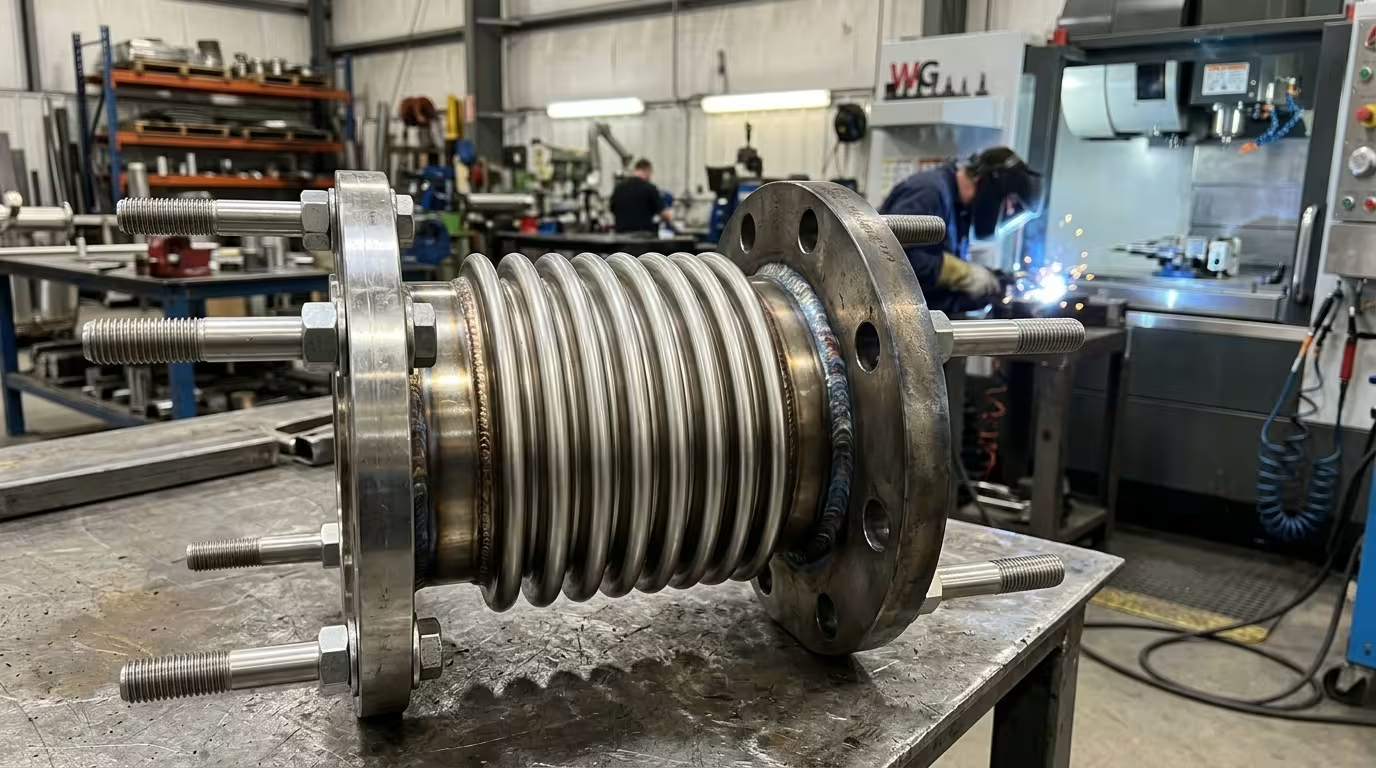
Multi-Ply SS 321 Convolutions
Precision welded with Class 150 companion flanges & tie rods
DN50 – DN2000
Diameter Spectrum
2" to 80" Nominal Bore
Up to 650°C
Thermal Resistance
SS 321 / SS 316L / Inconel
10,000+ Cycles
Fatigue Cycle Life
EJMA 10th Edition Standard
1.5x Design
Proof Test Pressure
100% Hydro & Air Tested
Exhaust Bellows Types Built for Extreme Cyclic Service
Every generator installation presents unique acoustic, vibrational, and thermal growth challenges. We manufacture four primary expansion bellows configurations tailored to your site piping.
Multi-Ply Flanged Generator Exhaust Bellows
Engineered specifically for turbocharger discharge outlets on Cummins, Perkins, Caterpillar, and Volvo Penta generators. Multi-ply thin-wall construction absorbs rapid engine vibration without transmitting stresses to the building piping.
Axial Expansion Joints with Internal Flow Liner
Equipped with a precision stainless steel inner sleeve (liner) that isolates convolutions from high-velocity exhaust gas flow (25-45 m/s). Prevents vortex shedding, eliminates whistling noise, and stops soot entrapment in the corrugations.
Universal Tied & Hinged Expansion Bellows
Incorporates heavy-duty perimeter tie rods with spherical washers to absorb large lateral offsets and angular rotation while restraining pressure thrust. Crucial for high-rise building exhaust risers undergoing multi-story thermal expansion.
Fabricated Rectangular & Large-Bore Duct Bellows
Custom rectangular, square, or large circular metallic expansion joints designed for gas turbine exhausts, industrial boilers, hot gas ductwork, and baghouse filtration systems. Handcrafted at our Unit 3 heavy sheet metal plant.
Why Multi-Ply SS 321 / SS 304 Bellows Outperform Single-Ply Designs
Single-ply bellows manufactured with thick steel sheets are inherently stiff. Under the high-frequency cyclic vibrations of 1500 RPM diesel engines, thick sheets experience high stress concentrations at the convolution crests and roots, leading to rapid work-hardening and premature fatigue cracking.
40% Lower Spring Rate
Multiple thin laminated sheets (e.g. 3 plies of 0.4 mm vs 1 ply of 1.2 mm) yield dramatically lower resistance to movement, isolating engine vibration without straining the generator turbo manifold.
SS 321 Titanium Stabilization
Titanium stabilization prevents intergranular carbide precipitation across the critical 450°C to 650°C diesel exhaust range, eliminating brittleness during continuous thermal cycling.
Aerodynamic Flow Liners
Smooth stainless steel inner sleeves prevent exhaust turbulence from exciting the bellows natural resonant frequency, avoiding vortex shedding whistling and internal soot clogging.
Bellows Performance Comparison
Lab TestedSuperior vibration damping, high pressure capability, zero weld root cracking.
High stiffness, susceptible to harmonic fatigue and thermal shock fractures.
Standard Exhaust Bellows Dimensions & Ratings
Standard dimensions for generator exhaust lines. Custom lengths, companion flanges, tie-rod assemblies, and larger bore sizes up to DN 2000 are fabricated upon request.
| Nominal Bore (NB) | Flange OD | Std. Length (OAL) | Axial Travel | Lateral Travel | Max Temp | Typical Generator Rating |
|---|---|---|---|---|---|---|
| DN 50 (2") | 152 mm | 150 mm | ±18 mm | ±4 mm | 600°C | 15 – 40 kVA |
| DN 80 (3") | 190 mm | 175 mm | ±22 mm | ±5 mm | 600°C | 50 – 82.5 kVA |
| DN 100 (4") | 220 mm | 200 mm | ±25 mm | ±6 mm | 650°C | 100 – 160 kVA |
| DN 150 (6") | 280 mm | 225 mm | ±30 mm | ±8 mm | 650°C | 200 – 380 kVA |
| DN 200 (8") | 340 mm | 250 mm | ±35 mm | ±10 mm | 650°C | 400 – 625 kVA |
| DN 250 (10") | 405 mm | 300 mm | ±40 mm | ±12 mm | 650°C | 750 – 1000 kVA |
| DN 300 (12") | 460 mm | 300 mm | ±45 mm | ±14 mm | 650°C | 1250 – 1500 kVA |
| DN 350 (14") | 520 mm | 350 mm | ±50 mm | ±16 mm | 650°C | 1750 – 2000 kVA |
| DN 400 (16") | 580 mm | 350 mm | ±50 mm | ±18 mm | 650°C | 2250 – 2500 kVA |
| DN 500 (20") | 700 mm | 400 mm | ±60 mm | ±20 mm | 650°C | 3000+ kVA / Utility |
* Custom lengths, multi-ply wall thicknesses, and special flange drilling (JIS, DIN, ISO) available upon technical drawing review.
4-Stage Quality Assurance at Unit 3 Ahmedabad Plant
Every stainless steel expansion joint is manufactured under ISO 9001:2015 certified quality controls with full traceability from raw steel coils to hydrostatic pressure certification.
Precision Coil Slitting & Tube Forming
Prime SS 304, SS 321, or SS 316L sheets are slit with laser precision. Tubes are longitudinally rolled with continuous micro-plasma or argon-purged TIG welding for zero seam defects.
Hydraulic & Mechanical Corrugation
Precision hydroforming dies expand multi-ply convolutions simultaneously, ensuring uniform wall thickness and stress-free corrugation crowns compliant with EJMA standards.
Flow Sleeve & Flange Integration
Internal aerodynamic flow liners and forged carbon steel or stainless steel flanges are fitted and welded with multi-pass TIG welding under inert gas back-purging.
100% Hydrostatic & Dye Penetrant Testing
Every assembly is tested to 1.5x design pressure. Convolutions and flange welds undergo liquid dye penetrant inspection (DPT) to ensure zero porosity or micro-cracks.
Related Exhaust & Noise Control Systems
Cummins Generator Silencers
Custom silencers for 15 kVA – 3500+ kVA Cummins engines with low backpressure.
Perkins Generator Silencers
CPCB-compliant silencers for Perkins 400 to 4016 series diesel engines.
Industrial Exhaust Silencers
Heavy mufflers for high-temperature engines, turbines, and industrial blowers.
Custom Heavy Fabrication
Turnkey ducting, exhaust chimneys, manifolds, and acoustic canopies.
Frequently Asked Questions on Exhaust Bellows
Key engineering considerations for sizing, selecting, and maintaining flexible stainless steel expansion joints.
Why are stainless steel exhaust bellows required in diesel generator exhaust piping?
Diesel engines produce violent mechanical vibrations and operate at exhaust temperatures between 450°C to 650°C. Rigid steel exhaust piping without flexible joints will transmit intense vibrations back into the engine turbocharger and cylinder head, leading to manifold cracking, bolt shearing, and gasket failures. Stainless steel flexible bellows absorb continuous engine vibration, isolate high-frequency harmonics, and accommodate thermal expansion as the exhaust piping heats up.
What is the difference between single-ply and multi-ply exhaust bellows?
Single-ply bellows use a single thicker sheet of stainless steel, which makes them stiff and susceptible to fatigue failure under high-frequency cyclic engine vibrations. Multi-ply bellows (typically 2-ply to 4-ply) use multiple ultra-thin laminated layers (e.g. 0.3 mm to 0.5 mm thickness). This design yields superior flexibility and dramatically lower spring rates while maintaining high pressure resistance and extended fatigue cycle life (10,000+ cycles).
Which stainless steel grade is best for generator exhaust bellows: SS 304, SS 321, or SS 316L?
For diesel generator exhaust lines operating between 450°C and 650°C, SS 321 (titanium-stabilized) is the engineering industry standard because it prevents chromium carbide precipitation and intergranular corrosion during continuous high-temperature cycles. SS 304 is suitable for moderate temperatures below 450°C, while SS 316L or Inconel 625 is specified for corrosive coastal environments, marine applications, or biogas exhaust systems.
Why is an internal flow liner (sleeve) critical in high-velocity exhaust bellows?
When exhaust gas velocities exceed 20–25 m/s, the pulsating gas flow passing across open convolutions causes turbulent vortex shedding and flow-induced vibration (FIV). This can cause acoustic resonance whistling, premature fatigue cracking of the convolutions, and soot accumulation in the corrugation roots. Bhavani Engineering equips all high-velocity generator bellows with smooth stainless steel internal flow liners.
Can Bhavani Engineering fabricate custom flanged bellows to match our existing engine or piping?
Yes. From our Unit 3 facility in Ahmedabad (Ahmedabad Mercantile Works - Bellows & Sheet Metal Division), we manufacture custom exhaust bellows tailored to any pipe diameter (DN50 / 2" to DN2000 / 80"). We supply flanges matching ANSI B16.5 Class 150, BS 10 Table D/E, IS 6392, or custom engine-specific turbo outlet bolt patterns (Cummins, Perkins, Volvo Penta, Caterpillar, Kirloskar).
Do you supply tie rods or limiters on generator exhaust bellows?
Yes. Tie rods or limit stops prevent the bellows from over-extending (squirming) under sudden exhaust pressure pulses or backfires during engine startup. For high-rise generator exhaust stacks with vertical runs, tied universal expansion joints ensure that thermal growth is guided axially without damaging the building structure or silencer mounting saddles.
What quality tests are performed on Bhavani Engineering exhaust bellows?
Every bellows manufactured at our plant undergoes 100% dye penetrant testing (DPT) on longitudinal and circumferential weld seams, hydrostatic pressure testing to 1.5x design pressure, and pneumatic air-under-water leak testing. We also provide raw material test certificates (MTC 3.1) and EJMA compliance design reports upon request.
Ready to Upgrade Your Industrial Noise Control?
Get a custom quote for your generator set silencers or exhaust systems today. Precision engineering meets rapid delivery.